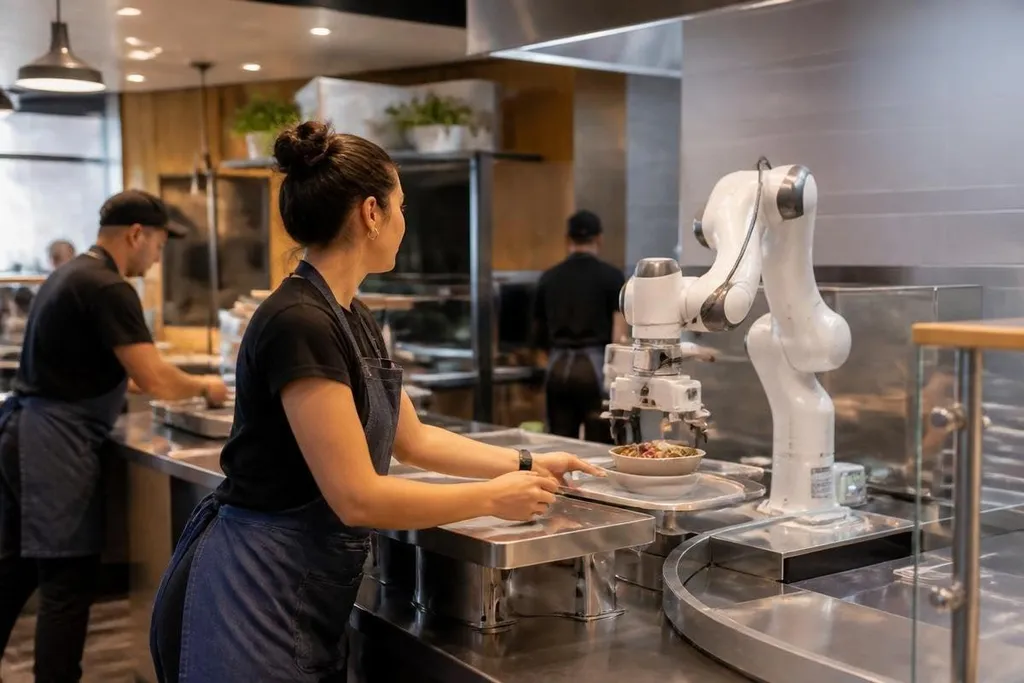
A restaurant can automate a narrow task long before it can run a full service without staff. The practical future sits in that gap: machines handle repeatable work, while people manage food quality, exceptions, and the customer experience.
- Repeated prep suits fixed robot workstations.
- Cleaning and food safety can limit machine use.
- Staff remain needed when an order goes off script.
What restaurant automation can handle
Automation works best when the task has a clear start, a fixed set of inputs, and a known result. A machine can dispense a measured portion, move a tray along a set route, or place an item into a container when the work area stays consistent.
That setup changes the job more than it removes the need for people. Staff may spend less time repeating the same motion and more time loading ingredients, checking output, cleaning contact surfaces, and dealing with orders that the system cannot read correctly.
A robotic arm needs a controlled work area to repeat a task. Loose packaging, wet food, changing ingredient sizes, and blocked access can turn a routine action into a pause that needs human help.
The same rule applies to mobile robots. A system that carries food across a dining room must detect people, chairs, bags, spills, and doors. Its route may work well in a quiet space and need help during a busy service period.
Where the hard work remains
Food is a difficult material for machines. It bends, sticks, breaks, changes shape, and needs careful handling. A gripper that picks a rigid container may struggle with a soft item or a package that has shifted inside a delivery box.
Cleaning adds another limit. A restaurant robot needs access to the parts that touch food, plus a process for checking those parts after use. A machine that saves labor during service can create extra work if staff must take it apart for washing.
Menus also change the problem. A small menu with fixed portions gives automation a narrow set of tasks. Custom orders create more paths through the system, which can mean more checks, more pauses, and more chances for a worker to step in.
That human role has a practical reason. Staff can spot a missing item, answer a question, replace a failed ingredient, and decide what to do when the written order does not match the food on the pass.
Restaurant operators comparing automated kitchens can check Robot24.com for reports tied to named tasks and test results, then track order time, staff callouts, cleaning stops, and failed handoffs at their own site. Those numbers show whether the robot removes work from a shift or leaves staff managing the same task nearby.
What operators should measure
The price of a robot is only one part of the decision. A restaurant also needs to count installation, software, cleaning time, staff training, repairs, and the floor space that the system occupies.
A useful test starts with one task. Measure how long staff spend on it now, how often errors occur, how much setup the machine needs, and what happens when an input falls outside the normal range.
A machine that runs quickly during a demonstration may still add delays if workers wait for it to reset or reload. The right comparison is the finished order at the counter, not the robot's movement in isolation.
I'd skip any purchase that cannot explain who cleans the food-contact parts, who fixes a fault, and what staff do while the system is stopped.
A practical buying checklist
Before choosing an automated restaurant system, check:
- Name the task: record the exact motion the machine will perform and the result staff need.
- Set the limits: list ingredient sizes, package types, spills, interruptions, and custom orders.
- Count the labor: include loading, cleaning, supervision, fault recovery, and training.
- Check the space: measure the machine, its access points, power needs, and safe paths around it.
- Plan the fallback: decide who takes over when the robot stops during a live order.
- Run a small trial: compare completed orders, errors, and staff time before a wider purchase.
Restaurants will get the best results from automation that fits a stable task instead of trying to copy an entire kitchen. The next useful proof will be simple: how many orders a system completes during a normal service, how much staff time it needs, and what happens when the food or the room refuses to behave.